
Nature of Mainland China
The People’s Republic of China possesses a vast territory approximately twenty-six times the size of Japan and a history extending back thousands of years. Its immense landmass encompasses a wide range of climatic zones, from subtropical to boreal regions. Although China began opening to foreign visitors in the 1980s, access to many border areas remains restricted even today. In 1989, together with the late Wako Kitawaki, the late Akira Takashima, and other colleagues, I undertook extensive surveys in Sichuan, Yunnan, the Tibet Autonomous Region, and Hainan Island, obtaining numerous significant results. During the following decade, I visited remote regions of China almost every year and was continually impressed by the extraordinary richness of its butterfly fauna. The total butterfly fauna of China, including Taiwan, is estimated to exceed 2,000 species, making it one of the most diverse butterfly assemblages in the world.
▼Click on a photo to view details.

Nature of Namcha Barwa
Namcha Barwa (alt.7,782 m) was once the highest unclimbed mountain in the world and was first ascended in 1992 by a joint Japanese–Chinese expedition. Only two years later, I traveled alone to the base camp area, where I discovered Parnassius imperator at an elevation of 4,540 m and subsequently described it as the subspecies P. imperator namchabarwanus. The region is exceptionally rich in natural beauty and biodiversity, with an abundance of alpine plants and other mountain organisms occurring throughout the area.
▼Click on a photo to view details.

Teinopalpus aureus
Teinopalpus aureus was discovered in Guangdong Province in 1922 and described as a new species in the following year. Its occurrence on Hainan Island was confirmed in 1988, and the species has subsequently been recorded from Vietnam and Laos. Wuzhi Shan (alt.1,867 m) is the highest mountain on Hainan Island and, as its name suggests, consists of five prominent peaks. Teinopalpus aureus visits the highest of these summits. From around 9:00 a.m., males begin to arrive and frequently settle on shrubs near the summit with their wings fully spread. After about 1:00 p.m., however, they become scarce and are seldom seen. Females usually pass high above the summit and only rarely descend to perch on the surrounding vegetation.
▼Click on a photo to view details.

Bhutanitis mansfieldi
Although two female specimens of Bhutanitis mansfieldi had been collected in Yunnan by the British plant collector George Forrest around 1918, the species was not described as new until 1939. For many years, the precise locality where the original specimens had been collected remained unknown. In 1981, Shun Umezawa and his colleagues of the Hokkaido Mountaineering Federation expedition, which aimed to climb Minya Konka in Sichuan Province, rediscovered the species in the foothills of the mountain. The rediscovery attracted considerable attention in the Japanese media. In 1989, the late Wako Kitawaki unexpectedly discovered the nominotypical subspecies in Tuguan Village, Yunnan Province. I later visited the locality myself. The species occurs there together with Bhutanitis thaidina, and its larval host plant is Aristolochia moupinensis.
▼Click on a photo to view details.

Luehdorfia longicaudata
Although this species was discovered in 1944 by Li Chuanlong in the Qinling Mountains of Shaanxi Province, it was not formally published until 1981. In 1989, Akira Takashima and I unexpectedly located a population of the species in the Qinling Mountains and discovered that its larval host plant was Saruma henryi (Aristolochiaceae). The species occurs sympatrically with Luehdorfia chinensis at this locality. Subsequently, additional populations were discovered in the Daba Mountains of Sichuan Province and in Shennongjia, Hubei Province.
▼Click on a photo to view details.

Parnassius acco przewalskii
In 1884, the Russian explorer Nikolay Przhevalsky and his expedition discovered this butterfly in the Burkhan Budai Mountains of Qinghai Province at an elevation of approximately 4,200m. It is currently treated as a subspecies of Parnassius acco. The butterfly is an exceptionally rapid flier, darting across rocky slopes above 4,000m with remarkable speed and agility, often too fast to follow with the eye.
▼Click on a photo to view details.
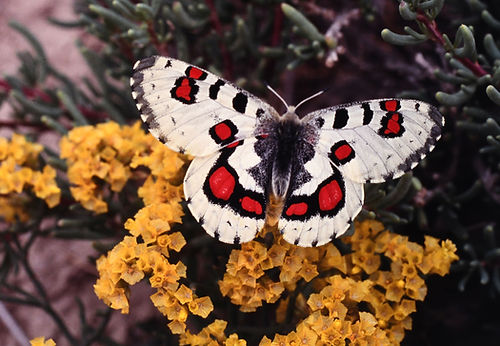
Parnassius nomion koiwayai
Parnassius nomion is a widespread species occurring from Siberia and the Russian Far East through northeastern China to the Korean Peninsula. A remarkable subspecies discovered by Satoshi Koiwaya in July 1987 at Angutan, Qinghai Province (alt.3,500 m), is characterized by the extensive development of red markings, which cover much of the wings and give the butterfly a striking appearance. Despite inhabiting an arid landscape where butterflies initially seem absent, large numbers of individuals can be seen flying together across the open terrain.
Unauthorized reproduction of photographs is prohibited.