
Nature of Myanmar
Myanmar is located in the western part of the Indochinese Peninsula and was formerly known as Burma. The capital was moved from Yangon (formerly Rangoon) to Naypyidaw in 2006. Following its independence from the United Kingdom after the Second World War, the country remained under military rule for many years. Although a period of democratic government followed, a military coup in 2021 returned the country to military control, and armed conflict between the military and resistance forces continues to this day.
Northern Myanmar forms the eastern extremity of the Himalayan mountain system and includes the country’s highest peak, Hkakabo Razi (alt.5,881 m). Hideo Shizuya first began entomological surveys in Myanmar in 1994, and Motoki Saito and I joined the expeditions from 1998 onward. Together, we explored remote and little-studied regions, including Kachin State in the north, Sagaing Region in the northwest, and Chin State in the west, resulting in the discovery of numerous new species and subspecies of butterflies.
Although Myanmar was under military rule during this period, restrictions on foreign visitors were gradually relaxed, allowing access to remote areas with official permits. Particularly remarkable was the extraordinary diversity of the tribe Theclini, a group of hairstreak butterflies well known and highly regarded among Japanese lepidopterists.
▼Click on a photo to view details.

A View of Snow-capped Mountains from the Subtropics
In May 2000, during an ascent of Pongkan Razi (alt.3,440 m) near the Indian border, snow-capped mountains came into view from Ziyadan at the foot of the range. I had never imagined that such a sight could be seen from a subtropical region. Near the summit, deep snow still covered the ground, and very few butterflies were encountered, apart from several species of Appias.
▼Click on a photo to view details.
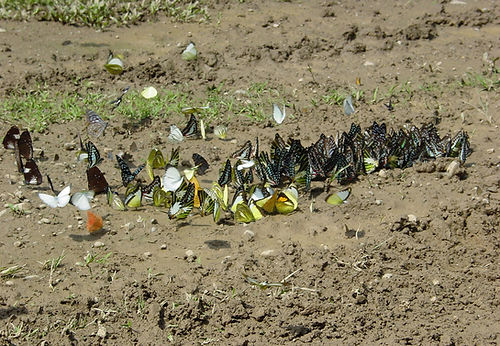
Butterfly Mud-Puddling Aggregation
While traveling to Pangsaung in Sagaing Region, northeastern Myanmar, we followed the historic Ledo Road, which was constructed during the Second World War by British and Chinese Nationalist forces. At an elevation of around 300 m, the route passes through the Hukawng Valley, a vast subtropical wetland. When sunlight reached the muddy, unpaved road, butterflies gathered in large numbers to engage in mud-puddling. Species of Graphium, Papilio, and Appias, together with the Magpie Crow (Euploea radamanthus), were particularly abundant.
▼Click on a photo to view details.
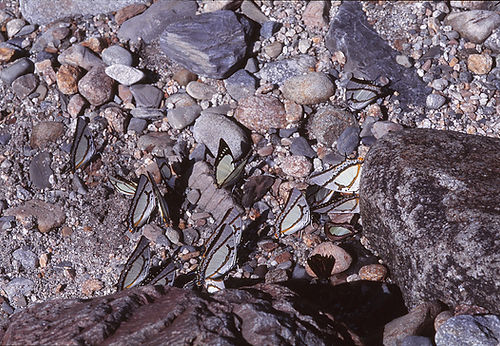
Mud-Puddling Aggregation of Polyura
A mud-puddling aggregation of Polyura forms along a riverbed at Ziyadan, Kachin State (alt.1,130 m), from around 9:00 a.m. Several species, including Polyura eudamippus, P. dolon, and P. athamas, gather together at the site. Other butterflies, such as Papilio krishna, are also attracted to the same mud-puddling area.
▼Click on a photo to view details.

Burmaozephyrus cothayaungi
A primitive member of the tribe Theclini, discovered in June 2012 by Hideo Shizuya and his colleagues in open stands of holm oak at an elevation of 2,200–2,300 m near Mindat, Chin State. It was described later that year by Satoshi Koiwaya as both a new genus and a new species. This small butterfly is brown in both sexes and bears yellowish-white markings on the forewing, giving it a superficial resemblance to species of Miletus. During the morning it is relatively inactive and may be found resting on the leaves of holm oaks and other vegetation. From the afternoon into the evening, however, it becomes active and flies in the forest canopy. The species was named in honor of Ko Thay Aung, a Myanmar guide who assisted the expedition.
▼Click on a photo to view details.

Abisara fylla
This species is also distributed in Assam and Thailand. The male bears a yellow oblique band on the forewing, whereas the female is predominantly yellowish white. In May 2014, the ascent route to Mt. Saramati (alt.3,826 m), the highest peak of the Naga Hills in Sagaing Region, passed through magnificent primary forest. Despite the excellent condition of the habitat, butterflies were remarkably scarce in both species diversity and abundance.
▼Click on a photo to view details.
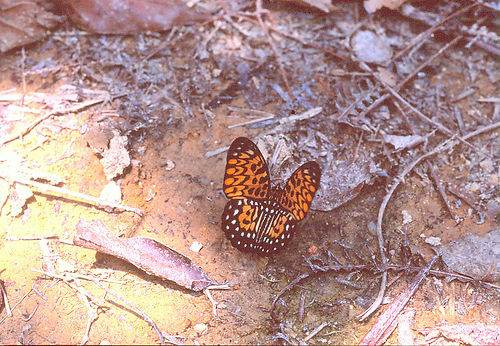
Neurosigma siva
A remarkable butterfly characterized by its distinctive fritillary-like pattern. Although formerly placed in the tribe Adoliadini, its phylogenetic relationships remain uncertain, and its early stages are still unknown. The species is distributed from the Himalayas through Myanmar and Thailand to Vietnam.
Unauthorized reproduction of photographs is prohibited.